

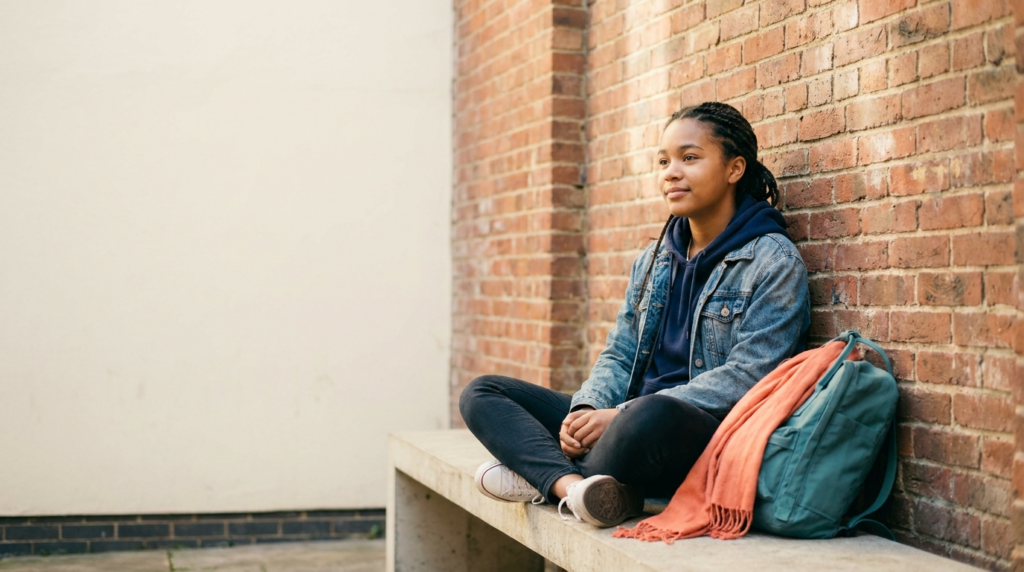
A student stands at the front of the room, about to give a presentation he has dreaded all week. His hands are shaking and his breath is high and fast. For a moment it looks like his nerves are simply going to run the show. Then he does something small. He takes a few slow breaths, feels his feet on the floor, and lets the first wave pass. When he starts to speak, he is steadier than anyone expected, including himself. Something shifted in the space of a minute: it was his relationship to what his own mind was doing.
Most teenagers have never been shown that this is possible. They know a great deal about the world outside them and almost nothing about the instrument they use to meet it. At Inner Strength, the first thing we teach is also the thing school rarely assigns: how your own mind works, and how to work with it.
The mind is a machine that makes thoughts
One of the simplest ideas we offer teens is also one of the most freeing. The mind is a kind of machine, and its job is to produce thoughts, the way the heart pumps blood or the lungs move air. Thoughts arrive whether we invite them or not. Some are useful, and many are just the machine running.
That reframe changes how a worried thought can take hold. “I’m going to fail” stops being a prophecy and becomes one more thing the mind generated. A teenager who can see a thought as a product of the mind, rather than a fact about reality, has room to breathe.
A worried thought is not a foregone conclusion. It is the mind-machine doing what it does–lungs breathe, brains think.
It helps to clear up a common misunderstanding here: Mindful awareness is not about emptying your head or reaching some blank, thought-free state, and teens (or adults!) who believe that is the goal usually end up feeling like they are failing at it. The real skill is noticing what’s present, seeing the thought or feeling or environment clearly, and choosing what to do next.
The hand and the thought
In class, we make this concrete with an exercise our founder Amy Edelstein created and one that students can remember long after the lesson ends.
Hold one hand flat in front of your face, palm almost touching your nose. That hand is a thought, and right now it is all you can see. It blocks the whole room.
This is what a strong thought feels like from the inside: total, obvious, the only thing there is.
Now spread your fingers. The room starts to show through the gaps. Slowly extend your arm. The hand is still there, the thought has not disappeared, but now you can see it as one object among many, held at a distance, with the whole room around it.
That distance is the entire point. The space between a teenager and a thought is where choice lives. For young people who often feel they have very little control over their circumstances, discovering they have some say over their own attention can be a genuine relief.
A brain that is still under construction
There is a good biological reason this skill matters so much during adolescence: the teenage brain is still being built. According to the National Institute of Mental Health, the teen years are less about the brain growing in size and more about fine-tuning how it works, and the prefrontal cortex, the region behind the forehead responsible for planning and good judgment, is among the last areas to fully mature, into the mid-twenties.
Part of that fine-tuning is a matter of keeping what gets used and letting go of what does not. Connections a teenager relies on grow stronger, and connections they neglect fade. This is why adolescence is such a powerful period for building inner habits. The mental moves a young person practices now are the ones their brain is actively reinforcing for later.
It is also demanding physical work. The brain makes up about 2% of body weight but uses roughly 20% of the body’s oxygen, a reminder that thinking, feeling, and steadying yourself are real effort, not abstractions. When a strong emotion floods the system, the reasoning part of the brain gets crowded out for a while. Learning to notice that moment, and to wait it out, is something teens can use in real time.
Mindfulness gives a teenager something small, durable and profound: an experience of choice.
Learning to think about thinking
The throughline of everything we teach is a capacity researchers call metacognition, and that we describe more plainly as helping teens think about how they think.
It sounds abstract until a student experiences it. It is the difference between being angry and noticing “I’m getting angry.” That small step back lets a teenager observe what their mind is doing while it is doing it. It does not make the feeling disappear. It gives the young person a place to stand that is not inside the feeling, and from there, more of their choices open back up.
From reaction to choice
One piece of self-knowledge lands especially well with teenagers, because it is concrete and they can test it for themselves.
The neuroscientist Dr. Jill Bolte Taylor, who studied her own brain while recovering from a stroke, describes what she calls the 90-second rule. When an emotion is triggered, the chemical surge that produces it moves through the body and flushes out in about ninety seconds. After that, what keeps the emotion going is the thoughts we keep feeding it.
For a teenager, that is useful information. A wave of anger or panic has a shape and an end. If they can ride out the first minute and a half without pouring more fuel on it, the intensity drops, and the choice about how to respond comes back to them. This builds self-awareness rather than suppression. When a young person sees that a feeling moves through and fades, they can meet it without being swept away by it.
A daily habit, like brushing your teeth
None of this works as a one-time lesson. It works the way physical hygiene works, as a small daily practice that becomes second nature. Children learn to wash their hands and brush their teeth until no one has to remind them. Mental and emotional hygiene works the same way.
For a teenager, that can look like:
- Three slow breaths on the bus before school
- A short pause between classes to feel their feet on the ground
- Letting a single anxious thought float off before falling asleep
The aim is to make these small resets ordinary, available, and theirs. It does not require thirty quiet minutes a day, which most teens do not have anyway. It asks only for the gaps that already exist in a normal school day.
A practice to try this week
This version of the hand exercise takes about a minute to lead at home or in a classroom.
- Invite the young person to sit comfortably, feet on the floor, and take one slow breath.
- Ask them to bring to mind one small thing that happened during the day that they didn’t like and hold one hand up close to their face, the way they would to block their view.
- Have them slowly extend the arm, watching the room reappear around the hand as it moves away.
- Notice together that the annoyance is still there, but it is now one thing in a much larger field, held at a distance they get to choose.
Keep it light. Keep it small and even a little humorous. The lunch treat that ran out before they got seconds, the gym class that got shortened for boring announcements.
Let them keep their eyes open or rest their gaze softly on the hand. There is no wrong way to do it, and if it feels like too much, it is completely fine to stop.
Inner strength for outer stability
When teenagers understand how their own minds work, something shifts that reaches well beyond any single class. They stop being at the mercy of the first thought that arrives. They gain a little distance, a little choice, and a steadiness they can carry into the rest of their lives.
When teens understand how their own minds work, they carry a steadiness that holds up outside the classroom.
That is what we mean by inner strength for outer stability. It begins with something as ordinary, and as quietly powerful, as learning to watch your own mind.


